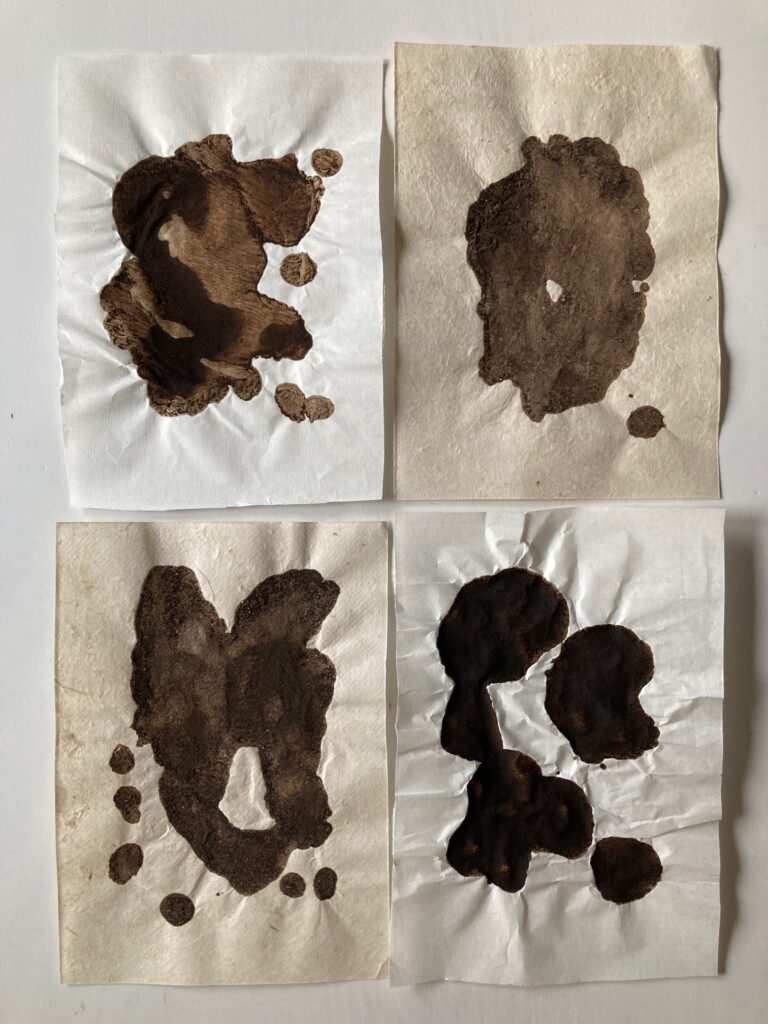
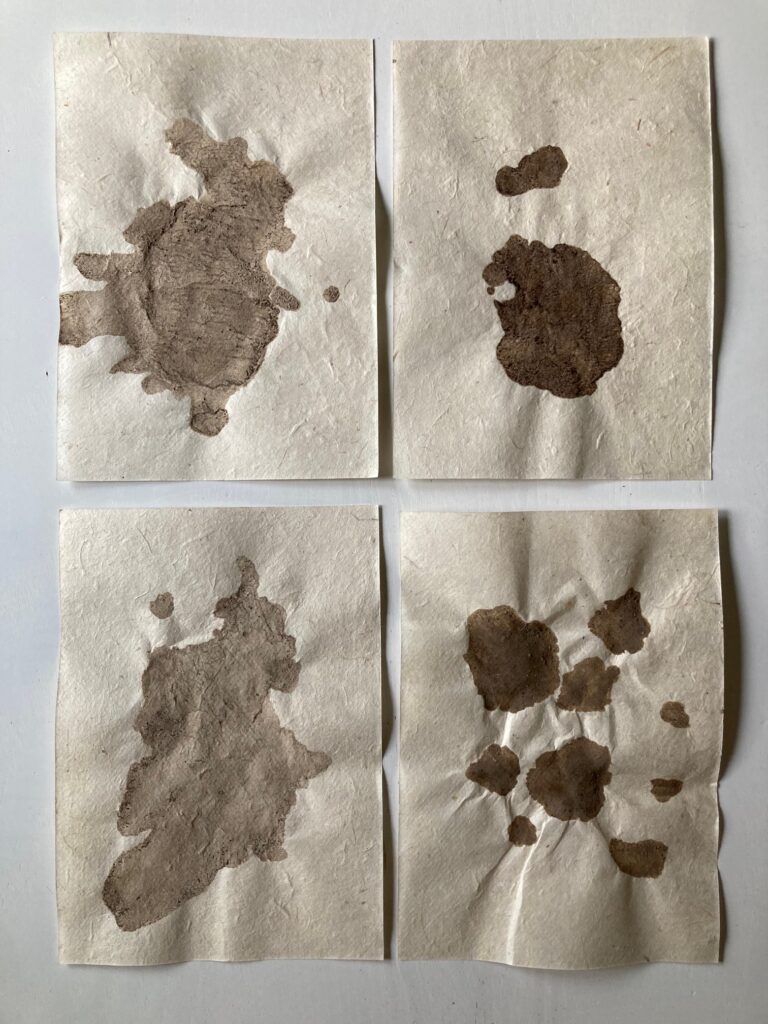
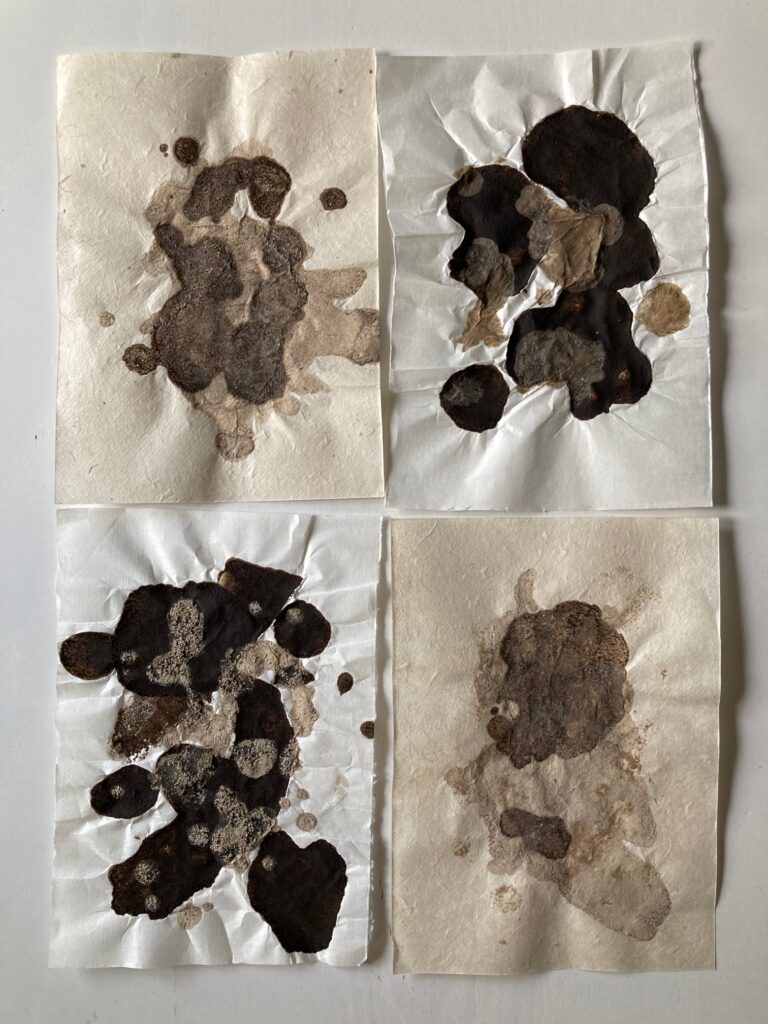
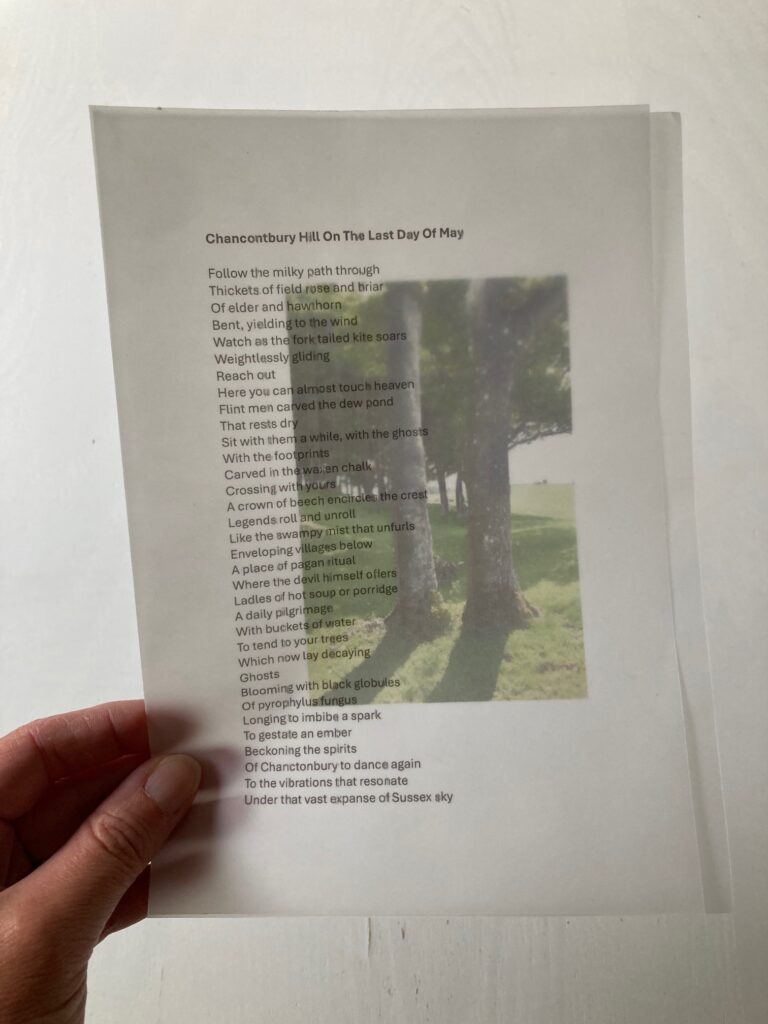
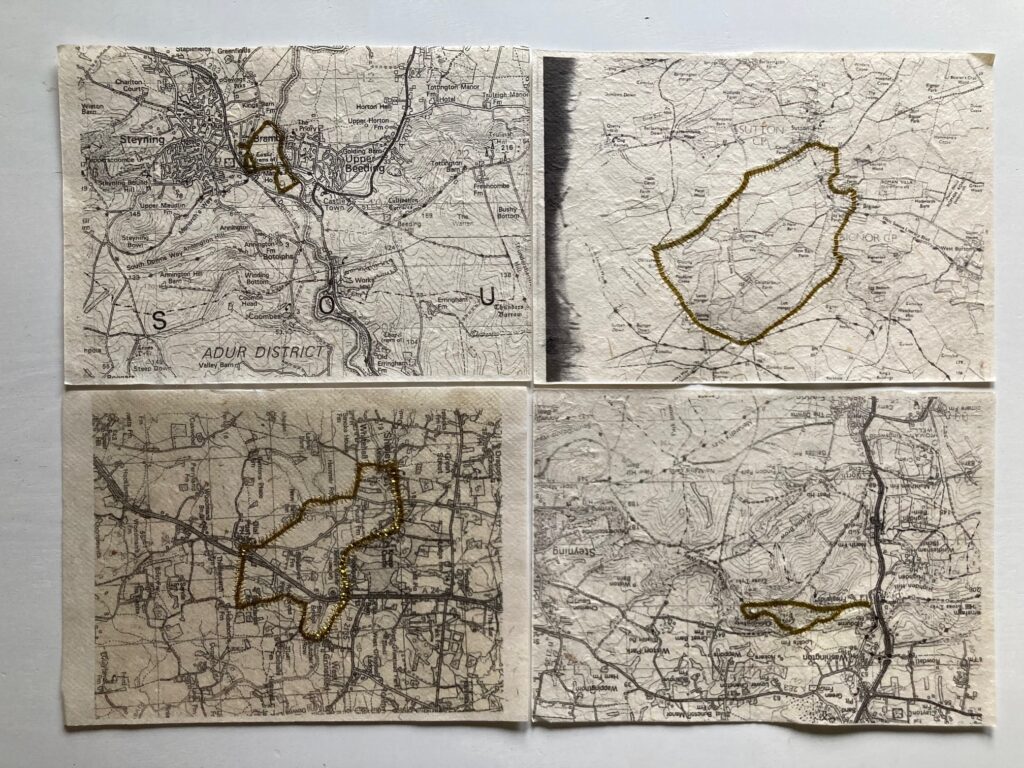
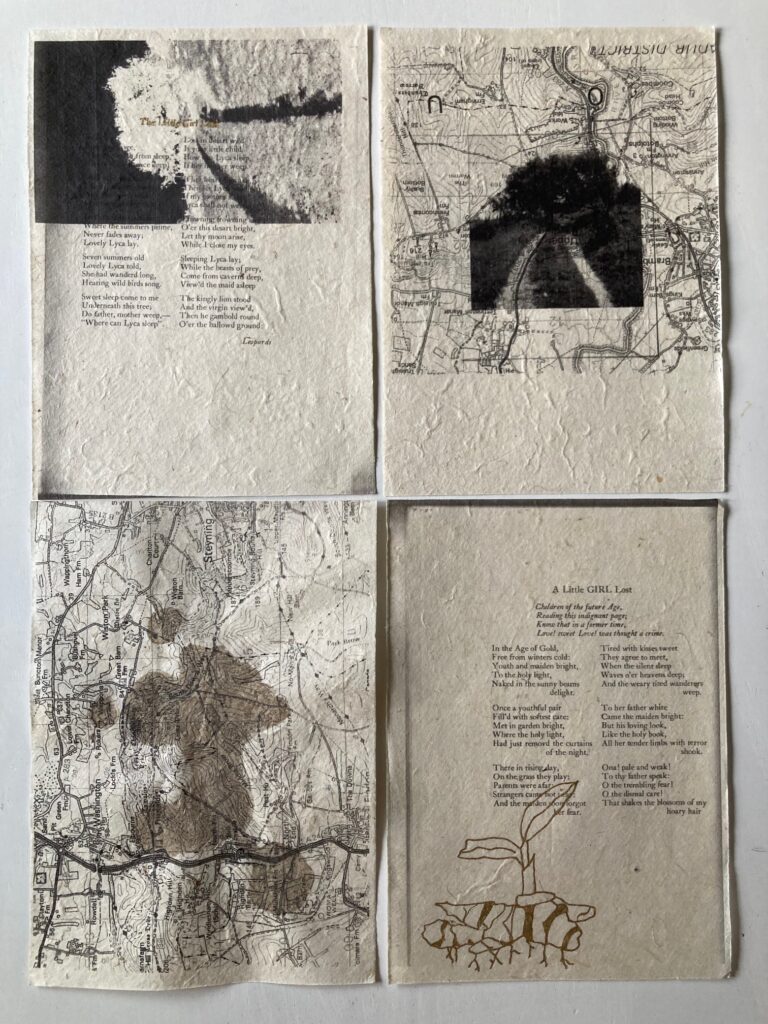
After experimenting further with creating different pigments, gathered from significant walks, I had the idea to layer the pigments in a palimpsest print. The process of layering the different pigments, from different but significant places to me (and historically), felt important, crucial, magical even. I kept renumerating – dare I say, critically reflecting – (Mezirow, 1990, p. 13) why? Why was I so compelled to make palimpsests. I’ve used earth over earth, photos and drawings over poetry by Keats, photos and prints over text by Belloc, stitched and printed onto OS maps. Even my own poems and photographs are printed on transparent velum so that you can see one through the other as you flick through a pamphlet. I keep re-reading the quote about this very act of transformation by Ingold: ‘To retrace in ink my path across the map, I would be judged to have committed an offence tantamount to writing all over the printed text of the book.’ (Ingold, 2016, p. 78).
Prompted by the MA to make sense of my making and the meaning behind it, I let this thought roll around in my mind, coming back to it in my reflective journal as I continued reading and making. Words have always been the thread for me – poems in my body of work, reading in the meaning making and journaling as an act of reflection.
I came to wonder if the palimpsest is a sort of symbolic enactment of the Jungian process of becoming my true self. Maybe it represents the multilayers, the unfolding of myself, the rhizomatic transformation (Deleuze and Guattari, 2013).
The palimpsest, by nature, is a layered document, each layer representing a previous version, gesture, or iteration of meaning. When I used the handmade earth pigments in the palimpsest prints, the process became deeply metaphorical and personal: the earth itself, ground and turned into pigments slowly and painstakingly mirrors the process I have experienced through this MA of uncovering the unconscious. Grinding soil into pigment is the what are you to my who am I.
This lead me to think that the palimpsest layers could be seen as representing the hidden elements of my psyche (the shadow, anima/animus, archetypes), the palimpsest print reveals a self in flux (another art movement I have been fascinated by, coincidence?), one that, like the landscape I am exploring, is formed slowly, not linear by rhizomatic, not clearly but in sediment, through revision and erasure. The translucent qualities of the pigments show the tensions between what I am willing to reveal about myself and what is hidden, echoing the slow but steady emergence of my authentic self. This makes me wonder if it was always there but hidden? If it was hidden, maybe I need to challenge the reasons I thought it was hidden for? (Troublesome knowledge in the liminal lands). After all, this is dangerous stuff. ‘Growing and reformulating our self-definition becomes a dangerous act. It is the act of transformation. (Gould, 1978, p. 25).
I like the ideas that a palimpsest is layered – like the self. Similarly to my earth pigments, it is made up of ‘multilayered sediments from the past’ (Tennant, 2012, p. 89). No one is a clean slate. I have come to realise that my transformative learning experience is rhizomatic, not linear, but made up of micro experiences and layers. I think this is why I am drawn to the palimpsest. I like the idea that in a palimpsest, you can see what has been before – you can see the works before that led to this moment, nothing is removed but built upon instead.
Each layer of pigment I put down covers what I printed before, but it does not erase it entirely, it influences the next surface. The physical act of printing (and why I am drawn to the raw, unpredictability of monoprint) with handmade earth pigments is slow, unpredictable, and responsive. The imperfections, the bleed-throughs, the interruptions in layering are not failures or mistakes but essential moments of authenticity. This really resonates with the body of work that I am producing and my practice as a whole. This idea that the rawness, unpredictability, imperfections, layers are a metaphor for my self. They embody the complexity of my self. They embody my journey to discovering my artist self. I don’t want to erase the imperfections, the times when I was uncertain, the texture and rawness because that is what is honest, authentic, automatic, unconscious. For me, this is where the real creative making is happening – a real expression of who I am. The funny thing is that I didn’t know who I was as an artist until I started experimenting and taking risks. It seems risk taking is a significant element of the birth of the authentic self.
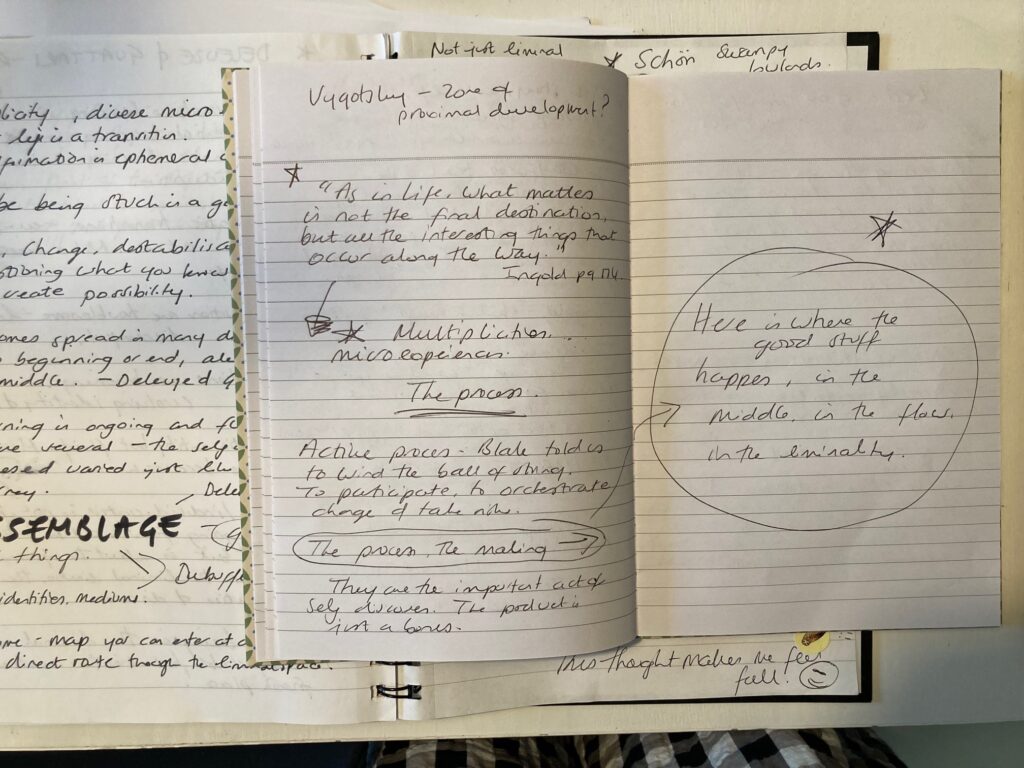
I think to layer handmade earth pigments in a palimpsest print is to stage a dialogue between material, memory, and self. It is to acknowledge that the self is never fixed, but always in the act of becoming. This is why I am so interested in the liminal, the in between, because that is where life and art really happen. The self (especially mine), is built from traces, sediments, and tensions between being hidden and emerging. The earth pigment, taken from the literal ground that I walk on, becomes a medium for exploring my self, where every print is not only a piece of art, but a topographical map of my self. The process is very active, reminding me that Blake called us to follow and wind, to participate, to orchestrate and be active agents of change; to take risks. It is ‘the conjunction, and…and…and…’ (Deleuze and Guattari, 2013, p. 26). The good bits, where stuff happens is in the state of being, doing, making, thinking, reflecting, questioning, challenging, that identity unfolds. It is ‘always in the middle, between things, interbeing, intermezzo’ (Deleuze and Guattari, 2013, p. 26), being stuck in the swampy low lands (Schon, 1983).
Gosh, I think that was a critical incident?
Just thinking all of this is frustrating. It is like the whole MA experience, I am on the precipice of understanding. I have all of it there at my fingertips, spread out on the map, spread out like a rhizome, a constellation of micro ideas. There is a tower of books beside me – Ingold, Jung, Schon, Gould, Tennant, Illeris, Mezirow, Piaget, Meyer, Land, Baillie, Deleuze, Guattari, Turner. My notebooks are open, pages and pages of scribbled notes, highlighting, arrows to this and that. The fully understanding is gestating. I just can’t thread it all together to make full sense of it yet and trying to makes me brain hurt! At the beginning, I found this experience really frustrating and stressful, ‘messy but crucially important’ (Schon, 1983, p. 43), now I feel like I can savour the liminal space more. The thrill of the chase of knowing I don’t know yet, but any day now I will and I know it will unlock a whole new thing for me to grapple with.
‘And I compared myself to a palimpsest; I tasted the scholar’s joy when he discovers under more recent writing, and on the same paper, a very ancient and infinitely more precious text’ (Gide, 2000, p. 44).
What was hidden is precious, who I was before I embarked on this (when I didn’t have a practice or a sense of self as an artist), is precious. It was just waiting for a catalyst to unveil it.
In the first module, and maybe in life in general, I was consumed by the question ‘Who am I?’. I have come to realise that I am many things, I am not static and fixed. I am in a state of flux, transformation and growth. It is fluid. It is not about going from the old me to the new me, but about the journey and the process, which has many routes and entry points. I think I am so preoccupied with palimpsest because they symbolise this realisation. The idea that we don’t have to be one thing, but can be many. Epochal moment.