The embodied practice became an integral element of the research inquiry. It is the Deterritorialising (Deleuze & Guattari, 2013) mechanism which creates the conditions for attending, liminality and transformation.
The embodied actions that I took are a form of tacit knowledge; they are intuitive and often occur spontaneously as a result of following my body and being open to seeing/experiencing things differently. Reflecting on this, after the journey in my reflective journal, brings the knowledge that has been acquired into my conscious awareness and thus making it explicit.
Embodied practice encourages presence, slowness, pausing, lingering, changes in direction. This type of embodied practice disrupts the everyday rhythms and efficiency of transport. The routines of using a car or simply walking from a-b, become so familiar that we stop noticing. When we become caught in these habitual routines of transport, our creative thought is stifled and the processes which are integral in the production of artist identity are unlikely to occur.
There are two main components of my embodied practice which I would like to explore further here. The first is Tim Ingold’s concept of ‘wayfaring.’ In wayfaring ‘things are instantiated in the world as theirs paths of movement, not as objects located in space. They are their stories. Here it is the movement itself that counts, not the destinations it connects’ (Ingold, 2022, pg. 198). This is in contrast to what Ingold calls transport which is ‘the displacement or carrying across of an already constituted, self-contained entity from one location to another’ (Ingold, 2022, pg. 198). This is a key concept in my inquiry. Wayfaring is about ‘trail-following’ (Ingold, 2022, pg. 196) and it is in this intuitive walking that knowledge is ‘generated’ (Ingold, 2022, pg. 189) and ‘integrated’ (Ingold, 2022, pg. 196). Thus wayfaring can be understood as knowledge through movement. Now that we understand that knowledge is generated through a wayfaring kind of movement as opposed to a transport kind of movement, I would like to argue that this also includes knowledge being generated through intuitive, embodied movement as opposed to walking as a tourist with a predetermined location or image in mind. Travelling as a tourist is ‘the movement of people to, and their stay in, various destinations (Urry, 2002, pg. 2). This movement is short-term, temporary and ‘there is a clear intention to return home within a short period of time’ (Urry, 2002, pg.3 ). These travellers are ‘a set of photographic images’ (Urry, 2002, pg. 129) and the point of their journey is to ‘track down and capture those images’ (Urry, 2002, pg. 129).
I propose that walking around a place like a tourist or transporting from a-b is the same as Lefebvre’s notion of linear rhythms. Lefebvre argues that in modern ‘present day life, the rhythmical is overwhelmed, suppressed by the linear’ (Lefebvre, 2014, Vol. 3, pg. 687). I have come to understand these repetitive, linear rhythms as activities like travelling to and from work, the school run, going grocery shopping etc. ‘The linear consists of journeys to and fro, the linear is the daily grind’ (Lefebvre, 2014, pg. 40). This echoes the kind of transport Ingold contrasted to wayfaring.
I propose that these rhythms can suppress spontaneity and reduce opportunities for creative engagement with place. By adopting Ingold’s concept of wayfaring which emphasizes movement, attentiveness, and knowledge that emerges through ongoing engagement with place, I am opening myself to ‘lines of flight’ (Deleuze & Guattari, 2013, pg. 291). In this sense, I have come to understand habitual routines as limiting creativity, while wayfaring invites creative becoming.
Wayfaring has forced me to walk more intuitively; I have been open in both my heart and mind to explore my village and, at the same time, myself. For me, this kind of walking is a more physical and sensory interaction with place, medium, equipment. It is an unfolding meshwork (Ingold, 2022) of rhizomatic experiences (Deleuze & Guattari, 2013).
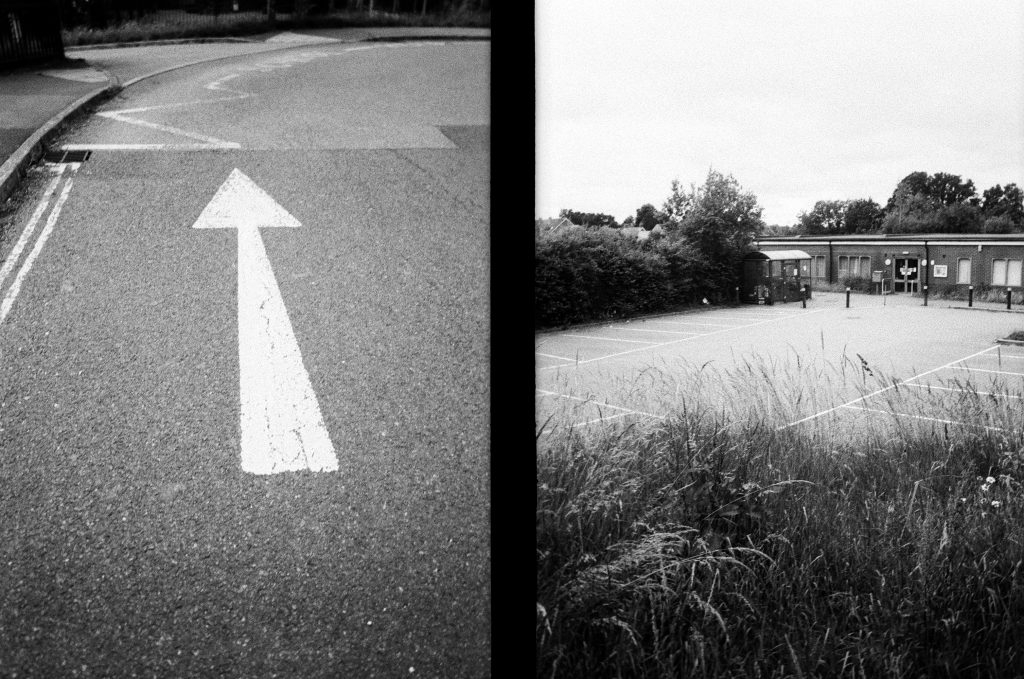
The second component of my embodied practice that I would like to discuss is my choice of analogue, black and white photography as a medium for gathering data and creating artwork in response to my wayfaring.
If wayfaring acts as an embodied process to disrupt everyday routines, tourist itineraries and familiar ways of seeing, then photography acts as part of that deterritorialising process. Where knowledge emerges through movement, meaning emerges through deciding what to photograph. It acts as a trace of movement, as a way of corresponding with place, rather than a representation of it. The photograph becomes evidence of the shift in attention. It is both an act of disruption and evidence of that act.
I would like to go further than André Kertesz when he said ‘the camera is my tool. Through it I give reason to everything around me’ (Berger and Mohr, 2016, pg.130). For me, the camera becomes the active conduit for the research rather than just a passive tool.
The choice of analogue over digital slows the process down; it encourages me to pause, attend, engage. Black and white film encourages a more attentive mode of looking. I find myself noticing texture, shadow, form, light; I find myself noticing things that are otherwise overlooked. The process shapes how I attend and respond, how I perceive. Point and shoot further heightens perception; it allows me to capture moments that would ordinarily be missed by the highly choreographed style of the tourist gaze (Urry, 2002).
There is a finiteness to shooting analogue. 75 photos per roll of film, one roll per walk. The mere process of ordering the film, loading the film into the camera, winding it on, pressing the shutter, returning the film to be developed, waiting for the resulting images. It is tactile, slow, sensory; this is embodied practice. It resists the linear, tourist like commercial consumption of place. The materiality, the grain, the imperfection are evidence of the process. It is through this embodied process, these acts of disruption, that my identity as an artist is becoming.
Berger, J. and Mohr, J. (2016) Another Way of Telling: A Possible Theory of Photography. London: Bloomsbury Publishing.
Deleuze, G. and Guattari, F. (2013) A Thousand Plateaus. London: Bloomsbury Academic.
Ingold, T. (2022) Being alive : essays on movement, knowledge and description. Oxon: Routledge.
Lefebvre, H. (2014) Critique of everyday life. London: Verso.
Lefebvre, H. (2014) Rhythmanalysis : space, time, and everyday life. London: Bloomsbury Academic.
Urry, J. (2002) The tourist gaze: Second Edition. London: SAGE