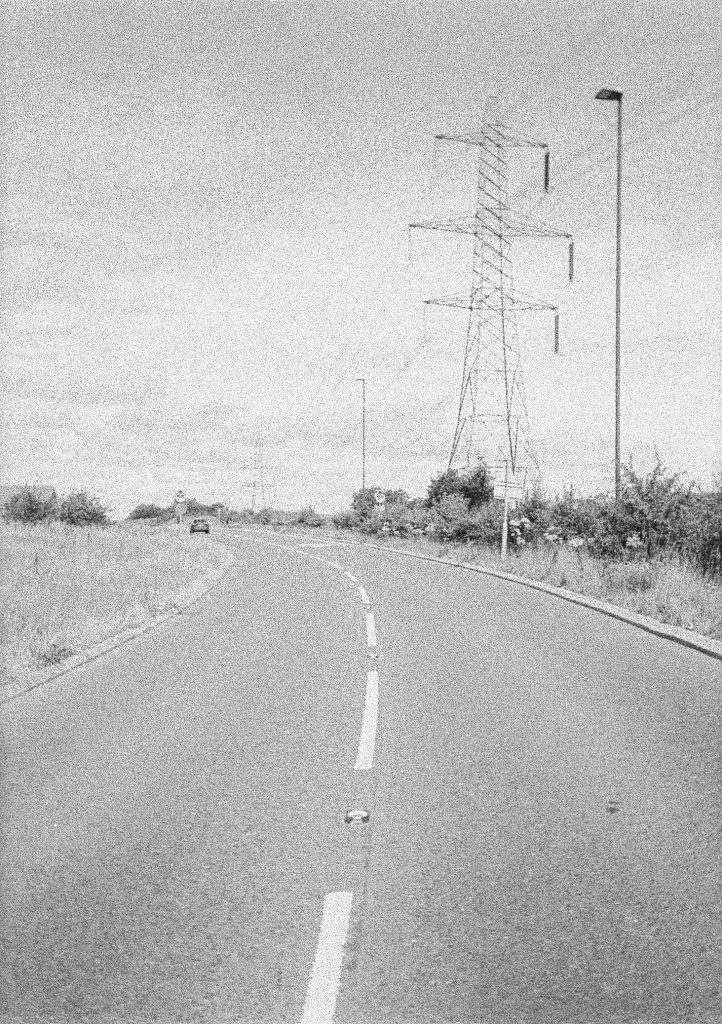
In this heuristic inquiry (Moustakas, 1990), I sought to argue that by disrupting the tourist gaze (Urry, 2002), through minor gestures (Manning, 2016), wayfaring (Ingold, 2022) and analogue photographic practice, you can deterritorialise (Deleuze and Guattari, 2013) and disrupt your habitual ways of seeing and, in turn, I wanted to discover what impact this would have on my emerging artist practice.
Through rigorous thematic analysis of the data that I gathered whilst carrying out the heuristic research, I am able to conclude that embodied practice as an intuitive process, naturally leads to the minor gestures of attending to the unnoticed and unexpected encounters, to disrupting the linear (Lefebvre, 2014) tourist gaze that stifles creativity, to embracing risk and uncertainty and, ultimately, to crossing through liminal spaces and passing over the threshold into new knowledge. Of course, the process is at times troublesome, uncomfortable and destabilising; this is the nature of deterritorialsing your identity.
However, I have discovered that the process is one of transformation and generating new knowledge. My eye was so often drawn, when my heart was open, to the liminal because the liminal, or the in between, is a place to be celebrated. In the middle is where the magic happens. The self is always in the intermezzo; it is always in the process of becoming.
The impact of this disruption and deterritorialization on my practice, and my identity, is that it has become more secure, more authentic, more of an expression of who I am. I am pleased with the photos that I have taken, with their materiality and how they force you to look again and consider. So much of my working life has been about habitual routine, there is little time to pause and open myself up to creativity. This embodied way of working has forced me to be more attentive, to slow down and to be intuitive and the results are positive.
The embodied practice created the conditions for deterritorialisation and the outcome of that deterritorialisation process is that my identity has emerged differently and is now reterritorialised (for now). I now have a new way of understanding the place I live and myself as an artist. I urge everyone to pick up an analogue camera and wayfare; leave ‘that familiar space and cross over into the riskier space beyond the threshold’ (Meyer et al, 2010, pg. ix).
Part of the generation of this new knowledge is owed entirely to the complementary and passionately compelling nature of heuristic inquiry. The indwelling, the incubation, the composting. I have lived and breathed the problem; I have lived inside it and it has lived inside me, after all, as Polyani said, ‘we endow a thing with meaning by interiorizing it and destroy its meaning by alienating it’(Polyani, 1969, pg. 146). I have come to understand that ‘knowing is an indwelling,’ (Polyani, 1969, pg. 134), it is an ‘unfolding of our understanding’ (Polyani, 1969, pg. 134), it is this unfolding that moves us (Manning, 2016) towards new knowledge and a sense of self.
After all, the self is the folding in of the outside. The self is always in the intermezzo of the folds, which are infinite; it is always in the process of becoming (Deleuze, 1993). Knowledge is not linear, but meshworked (Ingold, 2022 ); it is sprawling and spreading like a rhizome. The formation of new knowledge is disruptive, chaotic, exciting, uncertain. It is most definitely generated in movement, in walking, thinking, noticing, clicking a shutter and reflecting. For me, it is in the researching, the thinking, the reflecting, the making and the processes, that the meaning emerges. Then as a result of that new understanding, I know myself better and I better understand or recognise myself as an artist and why I am choosing the practices and mediums I am. I better understand what the meaning is in my making.
Deleuze, G. (1993) The Fold, Leibniz and the Baroque. Minneapolis: University of Minnesota Press.
Deleuze, G. and Guattari, F. (2013) A Thousand Plateaus. London: Bloomsbury Academic.
Ingold, T. (2022) Being alive : essays on movement, knowledge and description. Oxon: Routledge.
Manning, E. (2016) The Minor Gesture. Georgia: Duke University Press.
Meyer, J., Land, R., and Baillie, C. (2010) Threshold Concepts and Transformational Learning. Rotterdam: Sense.
Moustakas, C.E. (1990) Heuristic research : design, methodology, and applications. London: Sage Publications, The International Professional Publishers.
Polyani, M. (1969) Knowing and Being. London: Routledge.
Urry, J. (2002) The tourist gaze: Second Edition. London: SAGE.