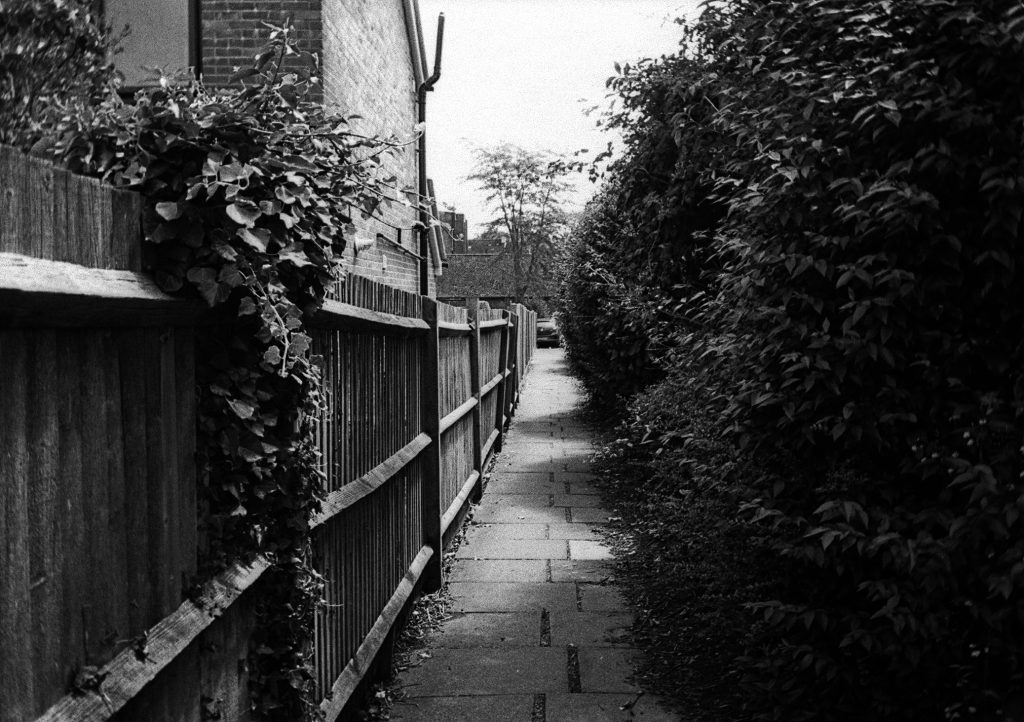
This theme explores the recurring experiences of being in-between. Many of my photographs include physical evidence of being in-between such as bridges, alleys, doorways, gates, even graveyards. The latent coding of these meant that they became symbolic of transition and becoming. The photographs become evidence of an ongoing process of negotiating place but also identity. The wayfaring became a liminal practice in a liminal space (changing nature of the village, temporal changes etc) and this came to represent, upon reflection, the liminal and ongoing process of identity formation. The whole dataset became a celebration of liminality and of being ‘betwixt and between’ (Turner, 1995, pg. 95). For it is in the in between that the good things happen! The painter is always between the ‘being and becoming’ (Lévi-Strauss, 1996, pg. 25). It is in the speculative middle, or ‘milieu’ or ‘middling’ where ‘everything is at stake’ (Manning, 2016, pg. 108). The self is always in the intermezzo (Deleuze and Guattari, 2013) of the folds, which are infinite; it is always in the process of becoming.
The self is negotiated by passing through thresholds. I realised the whole village became a threshold space and, as such, the village was not just a back drop, but a co-producer of my identity.
It is important to point out that two of the four rolls of film taken were shot as half frame. This is purposeful. The half frame is evidence of the speculative middle. It shows that the beginning and the end of the wayfare are not the most important but what occurs in the middle, the pause, the hesitation, the detour. It speaks of the process of becoming. It asks the viewer to attend too, as they wonder what is unfolding, what is happening in between, what are the possibilities? The middle, the space between, the process, the wayfare contains all of the unrealised creative potential, the multiple possibilities that lay open if you look for them.
The middle is ‘defamiliarising’ (Springgay and Truman, 2019, pg. 91), it is a ‘difficult place to be’ (Springgay and Truman, 2019, pg. 87), but it is where growth happens. One needs to accept the risk and uncertainty associated with the liminal.
Deleuze, G. and Guattari, F. (2013) A Thousand Plateaus. London: Bloomsbury Academic.
Lévi-Strauss, C. (1966) The savage mind. London: The University of Chicago Press.
Manning, E. (2016) The Minor Gesture. Georgia: Duke University Press.
Springgay, S. and Truman, S.E. (2019) Walking Methodologies in a More-than-Human World: WalkingLab. Oxon: Routledge.
Turner, V.W. (1995) The ritual process : structure and anti-structure. New York: Aldine de Gruyter.